There's not a lot to report with this post. The deer are still active but their antlers appear to be grown. You might also notice that they have rubbed the velvet off their antlers.
Here are some recent videos you may enjoy.
And a bonus video with a flying animal. It flies by pretty fast but I believe it's a bat.
And they are not horns. Antlers are a form of bone; they grow from a small button-shaped knob on the male deer's head called a pedicle. Only the deer family, Cervidae, grow them. The deer grow their antlers during the summer, in preparation for the rut. Sometime in midwinter the antlers fall off. After they fall off, they generally don't last long as mice, porcupines, and squirrels eat them as they are rich in mineral content.
Why they grow them is a question that scientists are still trying to answer. They require a great deal of energy to grow so they must offer some advantage. They don't seem to be defense against predators as only male deer grow them. If they were defense, we might expect females to also grow them. So, for males, they may be for fighting other males during the rut, or for attracting females.
"When it comes down to it, though, the only thing we can be sure of is this — why antlers? Because they're a handy weapon against other male deer! Drawing the attention of the ladies may possibly be just an extra (not primary) benefit." is the final conclusion of the Mississippi State University Deer Lab. You can read more here.
Horns, however, are for defense. They are grown by both the male and female of the family bovidae. Bovidae, are cloven hoofed, ruminant animals, such as cows.
The deer antlers at Cromwell are still covered in velvet. The velvet is a skin-like covering over the bone that supplies blood and nutrients to the antlers. After the antlers are grown, the velvet dies and the deer rub it off on trees. This is the cause of deer rubs, that you may have noticed at one time or another.
Below are some recent pictures of the deer at Cromwell Valley Park. Enjoy them, I hope.
Summer. That's my excuse for the delay since my last post. It's a pretty good summer in the family, though.
The camera has been in a couple different locations, and captured some interesting photographs. Three subjects seem to jump out from the rest. A family group of raccoon, both day and night; various birds in flight, and sitting on the camera; and the buck's antlers are coming out, still in velvet.
A disclaimer. Please disregard the date and time stamp. The camera got wet, and I had to dry it out. In the process I reset it and forgot to set the date and time. All the photographs in this post were taken in the last three weeks.
Raccoon family.
A set of photographs of a mother and children. Aren't these fun?
And maybe even more fun. The same family at night. Look closely. Those eyes are in there.
And in an open field, some birds, in flight and sitting on the camera.
And the deer are out in force. The yearlings are growing up, and the bucks are growing their antlers.
It's a beautiful world. Go outside and play in it.
Still no turtle. And that reminds me that I've also never caught a skunk on film.
I wonder why that is. There must be skunks in the area. They live in a variety of habitats and eat most everything. And apparently their population is growing like crazy in many cities. See this fascinating article in the most recent Outside magazine.
Someday, maybe, I'll capture a skunk.
Meanwhile, where I can't find a turtle, I have found some other animals.
You'll recognize this raccoon. And you may think that it is washing it's food--that's a commonly held belief. So commonly held that it's Latin name is "Procyon lotor". The lotor means one who washes, or washer.
Current thinking, however is that the raccoon is not washing its food, but that it has very delicate feeling in its paws. So it hunts by feel.
In the photographs to the right, the raccoon is hunting for food in the pond. Crayfish and other food found in ponds are a major part of the raccoon's diet.
The home range of the raccoon varies, but seems to be seven acres at a minimum. They especially like to be around water. Cromwell Valley Park has over 400 acres and a lot of water, so I expect has a pretty good raccoon population.
And here is a very wet mammal. I'm pretty sure it's a groundhog, probably the same one we saw in my last post. I didn't know groundhogs like water. But this one, at least, does.
My last picture is a two for one special.
You can see why another name for the raccoon is ringtail.
Take a close look at the center distance.
See those eyes?
Apparently the raccoon also saw those eyes.
It appears to have exited the scene to the right, and pronto. Then a fox ambles in to the scene nonchalantly.
Stay tuned. The camera is now looking for the mean troll under a bridge. Think I'll find one?
While I was casting about for a place to put the camera, the Naturalist suggested I try for a turtle.
I tried for a turtle.
I failed to capture a turtle on camera.
But I did get a groundhog, a deer, and a mystery.
.
Enjoy the videos.
I'm not entirely sure what this is. I think it is a moth flitting in and out of the image.
I have placed the camera in a couple different configurations, all overlooking the spring-fed pool along the blue trail. It looks like a place that ought to have quite a bit of wildlife. I suspect the problem is that I've put the camera at a couple odd angles. Not much for it though, as that's how the trees are growing. The camera is now looking at the pond from a different angle. Maybe I'll get that turtle yet.
Sorry it's been so long since my last post. After the beaver dam was washed away by the flood, I thought it might be fun to see if I could capture activity in the bluebird boxes.
Several dedicated volunteers in the park have maintained a trail of 27 boxes starting in 1994. For a variety of reasons, mostly habitat loss and pressure from invasive species, Eastern bluebird populations have plummeted. From this trail alone, though, over 1000 bluebirds have been fledged.
Huzzah for volunteers!
So, I found a tree close enough to a box that I thought I might see some fun bird activity. After two weeks, and fiddling with the location--no luck. I think this is because the birds are too small to activate the motion sensor on the camera. But I did find another fox.
Cromwell Valley Park is apparently fox heaven.
The second location
Then I thought that maybe I could find some bird activity with another strategy. I placed the camera overlooking Minebank Run. In the background, barely visible is a Belted kingfisher nest. I later learned that that nest was destroyed by a flood, and that the eggs in it are dead. Didn't know that at the time, though. The camera is set on time lapse. That is to say, it takes a photograph every five minutes all day.
I found a place with remarkably few animals. But I did find an interesting rain event.
On the 27th of May, at 5:42 pm and 5:54 pm there were two thunderstorms recorded, followed by rain at 0.05 inches of rain at 6:33 pm. Some more rain fell that evening, for a daily total of 0.30 inches. That is a trifle less than a third of one inch of rain.
(See httttp://www.wunderground.com/history/airport/KBWI/2014/5/27/DailyHistory.html?req_city=Baltimore&req_state=MD&req_statename=Maryland)
This video shows what that amount of rain looks like in Minebank Run.
You'll notice the rain in the first pictures. These small puddles correspond with the thunderstorms. Then, at 6:25 pm, about 30 minutes after the second thunderstorm...the water rises dramatically, and carries trash downstream. (See 7:05 pm.)
This rush of storm water, going too fast, carrying too many pollutants, and washing away the stream bottom, is one of the main causes of urban stream syndrome. (http://www.epa.gov/caddis/ssr_urb_urb2.html)
This is not a problem without solutions. A section of Minebank Run itself has just been restored by Baltimore County The city of Baltimore is making significant strides to reduce the amount of impervious surface in the city limits. What are you doing to help?
There is no sign of beaver activity in the park. I've no idea where they have gone, but I hope they are happy there. It'll be interesting to see how long it is until they return, or others move in to the park.
Meanwhile there are Baltimore Orioles, Orchard Orioles, and lots of other birds in the park. Why not stop by and see why the local baseball team picked those colors for their uniforms?
A Blue-gray Gnatcatcher has built a nest in a tree close to the Nature Center. Extra credit if you can find it as they are well disguised nests.
Beginning of a Chickadee nest. 17 May 2014.
And the camera is still out there. Last week I tried to capture an Eastern Bluebird on film and failed. I think because the camera was too far away from the nest box. Poking around today, I found the beginning of a Carolina Chickadee nest in one of the boxes. They are beautiful nests, made mostly of moss.
If I'm lucky, I will have some fun videos of a pair of Chickadees building a nest and feeding their young. Stay tuned.


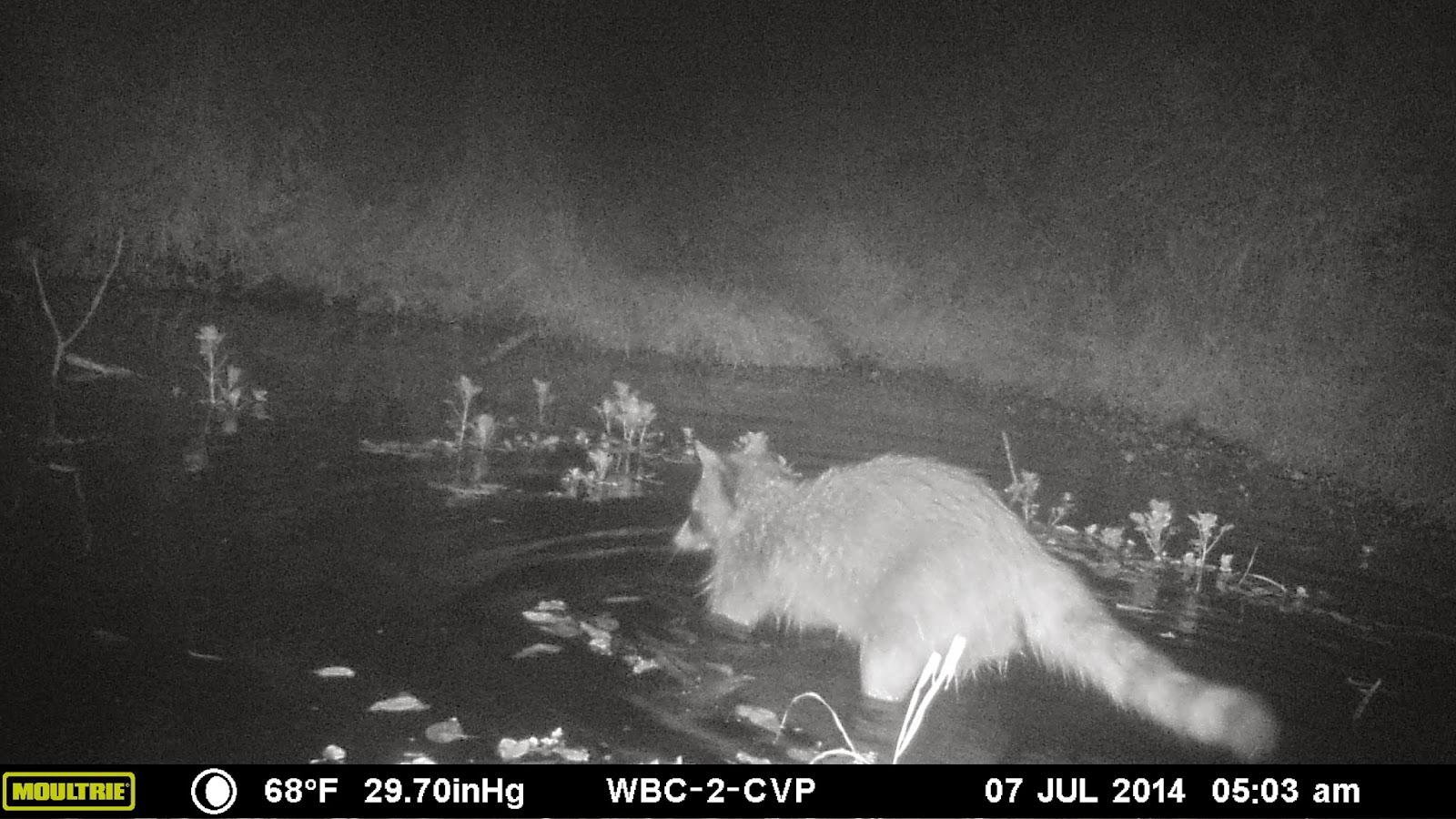
 In the photographs to the right, the raccoon is hunting for food in the pond. Crayfish and other food found in ponds are a major part of the raccoon's diet.

 It appears to have exited the scene to the right, and pronto. Then a fox ambles in to the scene nonchalantly.


